
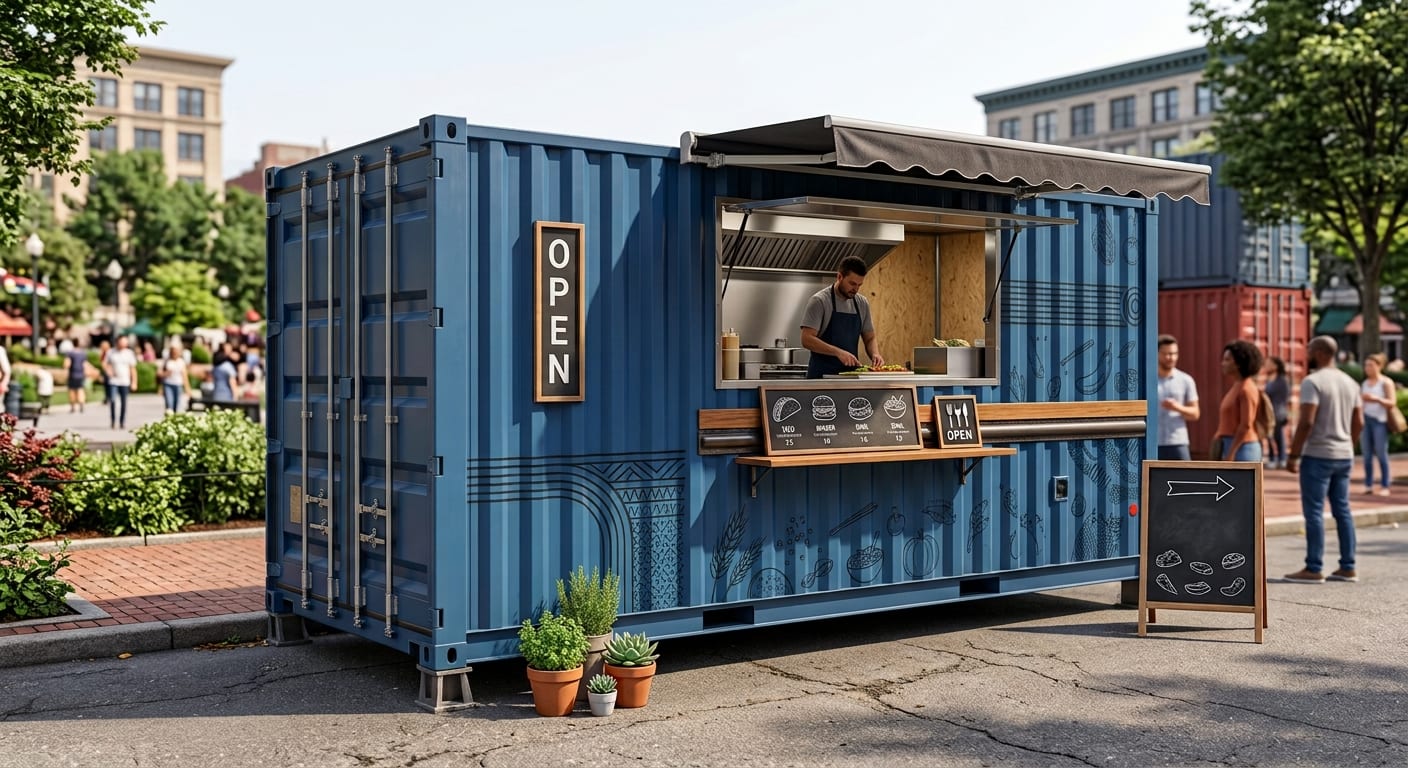
Located in Old Strathcona, shipping container food hub Station Park has become a incubator for rotating culinary concepts and international street foods.
Explore Station Park's rotating culinary concepts inside Old Strathcona's vibrant food hall
There is something quietly electric happening at the corner of Whyte Avenue and Gateway Boulevard in Edmonton, Alberta.
A development built from repurposed shipping containers has become one of the most talked-about culinary destinations in the city — not because of its permanence, but precisely because of its refusal to stand still.
Station Park, nestled at the edge of Old Strathcona, is rewriting what a food market can be in a mid-sized Canadian city.
Unlike traditional food halls anchored by long-term tenants and predictable menus, this shipping container food market operates on something closer to a living, breathing rhythm — rotating culinary concepts, independent operators, and pop-up residencies that keep the experience fresh every few weeks.
It is the kind of place that rewards repeat visits, because what you find today may not be what greets you next month.
Developed by Beljan Developments, Station Park was conceived as Edmonton's first shipping container and micro-retail development — a concept the team brought home after encountering similar spaces during travels abroad.
Inspired by container parks in London, Detroit, Toronto, and Las Vegas, the Edmonton version was adapted for the realities of an Alberta climate, marrying the spirit of industrial-chic street market design with practical year-round functionality.
The result is 21 micro-retail vendor spaces, an outdoor event stage, and a multi-floor food and beer hall that sits at the gateway to one of the city's most beloved neighbourhoods.
From the beginning, the model was clear: this was not a space for established chains looking for another outlet.
It was a platform for emerging chefs, market-stall veterans, basement bakers, and bold culinary dreamers who needed a low-risk environment to test original concepts without the crushing weight of a traditional commercial lease.
Commercial bays at Station Park range from just 157 to 316 square feet — intimate, manageable footprints that make experimentation financially viable for independent operators who might otherwise never get a foot in the door.
That philosophy has played out in real time, with remarkable results, over the past couple of years.
The space gained significant attention when EPIC Market opened its two-level food hall inside Station Park in August 2024, bringing together five distinct restaurant concepts and two bar concepts under one roof.
Designed as a social hub with expansive windows framing views of the Edmonton skyline, EPIC Market drew crowds curious about its mix of Italian pasta, Asian fusion dishes, cocktail menus, and casual bites — a deliberately eclectic lineup that reflected the neighbourhood's cosmopolitan character.
But the story of Station Park's food hall became even more interesting when EPIC Market departed earlier this year, citing challenges with foot traffic and parking on that particular corner.
Rather than leaving the space dark, what emerged from that vacancy was arguably more compelling than what came before.
A coalition of five independent local restaurants stepped in to fill the gap, launching a rotating pop-up residency that immediately captured the city's imagination.
The first wave arrived under a Japanese culinary theme, with operators including a ramen specialist, a Tokyo street food concept, a fresh mochi doughnut maker, a sweet cheese tart bakery, and a Japanese bistro all taking up residence simultaneously.
Practically overnight, the Old Strathcona food hall space transformed into something resembling a weekend market in Shibuya — ramen broth steaming, mochi glistening, tarts pulled hot from compact ovens tucked inside container bays.
The vendors operated in the afternoons and evenings, keeping the energy alive during the hours when the neighbourhood's foot traffic peaks.
As one of the participating restaurant owners put it, the appeal of the format was mutual and immediate — none of these operators are backed by deep-pocketed investors, and the chance to reach new audiences without signing a years-long lease is not a small thing.
The pop-up model strips away one of the most paralyzing risks in the restaurant industry and replaces it with something closer to creative freedom.
That first Japanese-themed series was curated directly by Beljan, the developers behind Station Park, and it set a template for what would follow.
A second rotation arrived not long after, and the culinary geography shifted dramatically — this time, the vendors represented Malaysian, Filipino, Indonesian, Vietnamese, and Ukrainian cuisine, turning the food hall into an entirely different destination within the span of a few weeks.
The Old Strathcona Business Association has taken note of the model, acknowledging that the rotating residency format removes the pressure of long-term commitment and gives emerging businesses a genuine pathway to new customers and visibility.
It is the kind of institutional validation that matters in a neighbourhood with a fiercely protective identity — Old Strathcona has long been Edmonton's creative and culinary heartbeat, and anything that earns endorsement here carries weight.
Meanwhile, the broader Station Park ecosystem continues to evolve beyond the food hall walls.
Among the vendors who have made their home in the container bays is Pebre & Co., a Chilean street food vendor serving hand-folded, oven-baked empanadas alongside small-batch pebre sauce and cold brew yerba mate.
It is exactly the kind of micro-concept that the development was designed to nurture — deeply personal, rooted in family tradition, and presenting a culinary perspective that simply would not exist in Edmonton's dining scene without a low-barrier entry point like this one.
Other tenants have included gift shops, clothing boutiques, and specialty retailers, all operating within that same tight, flexible footprint that defines the Station Park experience.
What makes the shipping container food market model so relevant right now is not just its novelty — it is what it signals about the direction of urban food culture in cities like Edmonton.
Across North America, the most exciting culinary energy is increasingly concentrated in spaces that resist permanence: pop-up dinners, rotating residencies, shared kitchen collectives, and micro-vendor halls where the lineup changes with the season.
Station Park arrived in Edmonton ahead of that curve, and the city's appetite for what it offers has only grown.
The commercial real estate dimension of the development is also worth noting for anyone watching Edmonton's urban growth patterns.
Short-term and long-term lease opportunities remain available inside the complex, with flexible terms specifically designed to accommodate the kind of seasonal or concept-testing operators who power the rotating model.
The location itself — at the intersection of Gateway Boulevard and 82 Avenue, right at the entry point to Whyte Avenue's commercial corridor — means that any vendor here is immediately accessible to the dense foot traffic that the neighbourhood generates on evenings and weekends.
For Edmonton's growing community of independent food entrepreneurs, that combination of visibility, flexibility, and low financial exposure is rare and genuinely valuable.
The station park edmonton story is still being written, and that is precisely the point.
A food destination that reinvents itself every few weeks is one that never grows stale, never becomes predictable, and never stops giving the neighbourhood a reason to show up.
In a city that has sometimes struggled to hold onto its most adventurous culinary concepts, Station Park has found a structure that makes the adventure itself the constant.
That sense of perpetual discovery is not accidental — it reflects a deliberate philosophy from the developers who understood early that the container park format lives or dies by its ability to surprise.
Year-round activation of the courtyard keeps community interest steady even between vendor rotations, with the outdoor event stage hosting gatherings that reinforce Station Park's identity as a neighbourhood anchor rather than a transient experiment.
Local business leaders have pointed out that developments like this one offer something the traditional retail strip cannot easily replicate — a curated mix of independent voices, each one betting on themselves, sharing the same industrial-cool environment and feeding off each other's energy.
Whether you arrive for Chilean empanadas baked to order, a bowl of hand-pulled ramen, or simply the pleasure of wandering through a market that feels alive and unpredictable, the Old Strathcona food hall at Station Park delivers something that few permanent restaurants can match: the genuine sense that something new is always just around the corner. |
0 Comments
Join the conversation
Be the first to comment
Share your thoughts above.